Simple Deeds of Mercy
For I was hungry and you gave me something to eat, I was thirsty and you gave me something to drink, I was a stranger and you invited me in, I needed clothes and you clothed me, I was sick and you looked after me, I was in prison and you came to visit me.' Matthew 25:35-36
Whom did Christ expect us to care for? Who did He call the least in the world's eyes? Those who have no standing in society. Those who do not have the means to live from day to day. Those who are lonely and in need of comfort and strength to face each day. When we reach out to those in need (the least) through simple deeds of mercy, it shows that we are listening to the voice of our Heavenly Father. Christ said my sheep follow me because they know my voice (John 10:3). We are called to practice these deeds from day to day.
On the day of final judgement, Christ will separate those who have practiced deeds of compassion from those who have not. In his parable he refers to them (Matthew 25: 31-46) as sheep and goats. The sheep are those who go out of the way to reach out to those in need and are sent to live in Heaven. As the parable indicates they feed the hungry, give drink to the thirsty, clothe those who have need of them, care for the sick, and visit the prisoners. While the goats are those who did nothing to lend a helping hand to those in need and are sent away to Hell.
Jesus said that He lays down His life for His sheep (John 10:15). As sheep of His flock it means to realize that it is not our good deeds, but the sacrifice of Christ on the cross that gives us eternal life. This gift of grace calls us to lay down our lives to follow in the way that Christ calls us to go. How can we say our God is love, when our brother or sister is in need? As we grow in our faith we begin to hear the voice of Jesus calling us to reach out to those in need through simple deeds of mercy.
Sunday, December 09, 2007


Friday, November 30, 2007
Stay Awake Be Prepared
Therefore keep watch, because you do not know the day or the hour. Matthew 25:13
It is still a custom in many traditions where the bridegroom comes at night to claim his bride along with his friends. Jesus used this tradition as a parable to picturize His return. Jesus depicted the Kingdom of Heaven to the story of 10 bridesmaids who were expectantly waiting for the arrival of the Bridegroom. 5 of them came prepared with extra oil and the others came with nothing extra. When the Bridegroom arrived after considerable delay the 5 who had no extra oil asked for some for their lamps. The other 5 who were prepared replied they did not have enough for all of them. So when they returned after getting their lamps lit the Bridegroom refused them entry stating that He did not know them.
Jesus denied them entry into the celebration because he did not know them. Do you know Jesus? Do you have a personal relationship with Him? How deep is this relationship? It is proven fact that relationships grow stronger particularly if they are built during times of stress and hardships. Our relationship cannot be acquired, inherited, bought or borrowed at the last minute.
What is this Kingdom of Heaven that Christ spoke off? He was talking about heaven, earth and even the hearts of all believers. We have to come to Jesus in repentence and humbly restore our hearts that often stray away from Him. Here the 10 bridesmaids were all anticipating the coming of the Bridegroom but only 5 were prepared. Jesus was showing us that there is a difference between knowing about His return and being prepared for his return. Jesus is cautioning us to be on the alert, stay prepared, and be awake.
Thursday, November 29, 2007
Signs of the Times
Jesus answered: "Watch out that no one deceives you. For many will come in my name, claiming, 'I am the Christ,' and will deceive many. Matthew 24:4
Today there are many who claim to know and understand the signs of the times. They claim that the world will end shortly. However this question had been in the minds of even the disciples who when they asked Christ, " What will be the sign of your coming and of the end of the age?" His advice to them was not to let any one mislead them. Not to be carried away by wars, persecution and even by many who will do great miraculous signs. All Christ desires of us is to live our lives in a manner that will bring glory to God. It is very easy to spend our time in fear or inactivity of the time when the world will come to an end.
The coming of Christ will be like a thief at night. Christ said that ,"the Son of Man will come at an hour when you do not expect him." Matt 24:44 So how can we prepare for the Second coming.? Christ cautions us not to break our heads over these things but to spend our time in looking for ways to spread the gospel or to help our neighbor. Look for ways to deepen our relationship with Christ and our Fellowmen. Paul urges us not to sink into a state of inactivity but to be watchful, pray and exercise discipline in everything.
If we knew that Christ was coming tomorrow what will we do today? We need to be a light to the encompassing darkness around us (Matthew 5:14). Christ urged us to live our lives in a manner that men may see His light shinning through our lives, through our actions and our words. In this day of reality TV are our lives a living reality of Christ's love? We need to listen, understand, and act on what the Spirit of Christ is telling us to do today.
Monday, June 25, 2007
Lifting the Human Veil
In Christ we have boldness and access God with confidence by the faith Him. Eph 3:12
Tozer in his book "The pursuit of God" says, "Self is the opaque veil that hides the Face of God from us.” Many of us are so self-sufficient today that we barely sense the need for God. How can we tear this veil of self sufficiency today?
He goes on to say, "Let us beware of tinkering with our inner life in hope ourselves to rend the veil. God must do everything for us. Our part is to yield and trust." Often we try hard on our own to make our inner lives stronger scarcely realizing that it can be only done by the working of the Holy Spirit in our hearts and minds. All we have to do is yield and trust God to complete the work he has started.
Moses in Exodus 33:18-23 pleads with God to see his glorious presence. Yet God denied this request by saying that no one can see His face and live. Later Philip longed to see God the Father, and asked Jesus to reveal Him to them that they may be satisfied. But Christ’s words to him were, “Don't you know me, Philip, even after I have been among you such a long time? Anyone who has seen me has seen the Father. How can you say, 'Show us the Father'? Don't you believe that I am in the Father, and that the Father is in me? The words I say to you are not just my own. Rather, it is the Father, living in me, who is doing his work. Believe me when I say that I am in the Father and the Father is in me; or at least believe on the evidence of the miracles themselves (John 14: 9-11).”
If we yield ourselves to Jesus, He will lift this veil of self that separates us from God, and restore us into an abundant life in the glorious presence of His mercy and grace.
Wednesday, June 20, 2007
A Prayerful Reflection on the Blessedness of Being Poor in Spirit
Heavenly Father,
As we reflect on the profound words spoken by your Son, Jesus, in the Sermon on the Mount, we are reminded of the blessedness of being poor in spirit. We acknowledge that in our weakness, we find strength, and in our emptiness, we find fulfillment in You.
Lord, we come before you with hearts longing for deeper intimacy with You. We have tasted Your goodness, and yet we hunger and thirst for more of Your presence in our lives. Help us to recognize our insufficiency and to yearn for a deeper encounter with You, O God.
Forgive us for the attachments we hold to worldly pleasures, for the reluctance in our hearts to fully surrender to Your will. Father, we confess our desire to know You more deeply, but we tremble at the thought of letting go of the comforts and securities of this world.
Yet, in the midst of our struggle, we cling to the hope found in Your transformative grace. Root out from our hearts all that hinders true union with You, O Lord. Strip away our earthly desires and dependencies, and fill us with a longing for Your presence alone.
Lead us on this journey of spiritual poverty, not in despair, but in hope. May we find solace in the promise of Your kingdom, where the lowly are exalted and the weak are made strong. Help us to embrace our poverty of spirit as a blessing, for it is in our emptiness that we are filled with the fullness of Your love.
Renew within us a clean heart, O God, and create in us a right spirit. Guide us ever deeper into the blessedness of being poor in spirit, that we may find true fulfillment in You alone.
In the name of Your Son, Jesus Christ, we pray.
Amen.
Wednesday, June 06, 2007
Trusting in God's Sovereignty
Finding Peace in the Midst of Tribulation:
In a world fraught with uncertainty and adversity, finding peace can often feel like an elusive pursuit. Yet, amidst the chaos and turmoil of life, there shines a beacon of hope: the steadfast promise of God's presence and deliverance. As we journey through the ups and downs of existence, let us take solace in the timeless words of John 16:33, where Jesus assures us, "These things I have spoken unto you, that in me ye might have peace. In the world ye shall have tribulation: but be of good cheer; I have overcome the world."
Indeed, the reality of tribulation is an undeniable aspect of the human experience. As the psalmist declares in Psalms 34:19, "Many are the afflictions of the righteous: but the LORD delivereth him out of them all." In the face of adversity, it is natural to question the fairness and purpose behind life's trials and tribulations. Yet, even in the midst of suffering, we can find comfort in the unwavering faithfulness of our God.
Author Max Lucado beautifully encapsulates this truth when he reflects, "Bad things happen—tragic and horrible things. Good things happen—amazing and miraculous things. And all this happens randomly to us. But it is not random to the God who cradles our aching hearts. He knows. . . . Suffering will come. But God is . . . larger than the events that seem to contradict God’s goodness."
While sickness, accidents, sorrow, and death may be inevitable companions on our earthly journey, we are not left to navigate these trials alone. Proverbs 17:22 reminds us, "A cheerful heart is good medicine, but a crushed spirit dries up the bones." In the face of adversity, may we cling to the hope found in God's promises, allowing His peace to permeate our hearts and minds.
As we confront the challenges of life, let us anchor our trust in the unchanging character of God. He is the One who holds the universe in His hands, guiding us through the storms with unwavering love and grace. Though the road may be fraught with obstacles, we can walk forward with confidence, knowing that our ultimate deliverance rests in the hands of the One who has already overcome the world.
In the midst of tribulation, may we find peace in His presence, strength in His promises, and hope in His unfailing love. For He is our refuge and our strength, a ever-present help in times of trouble (Psalm 46:1).
Right Moves
911 - Wisdom
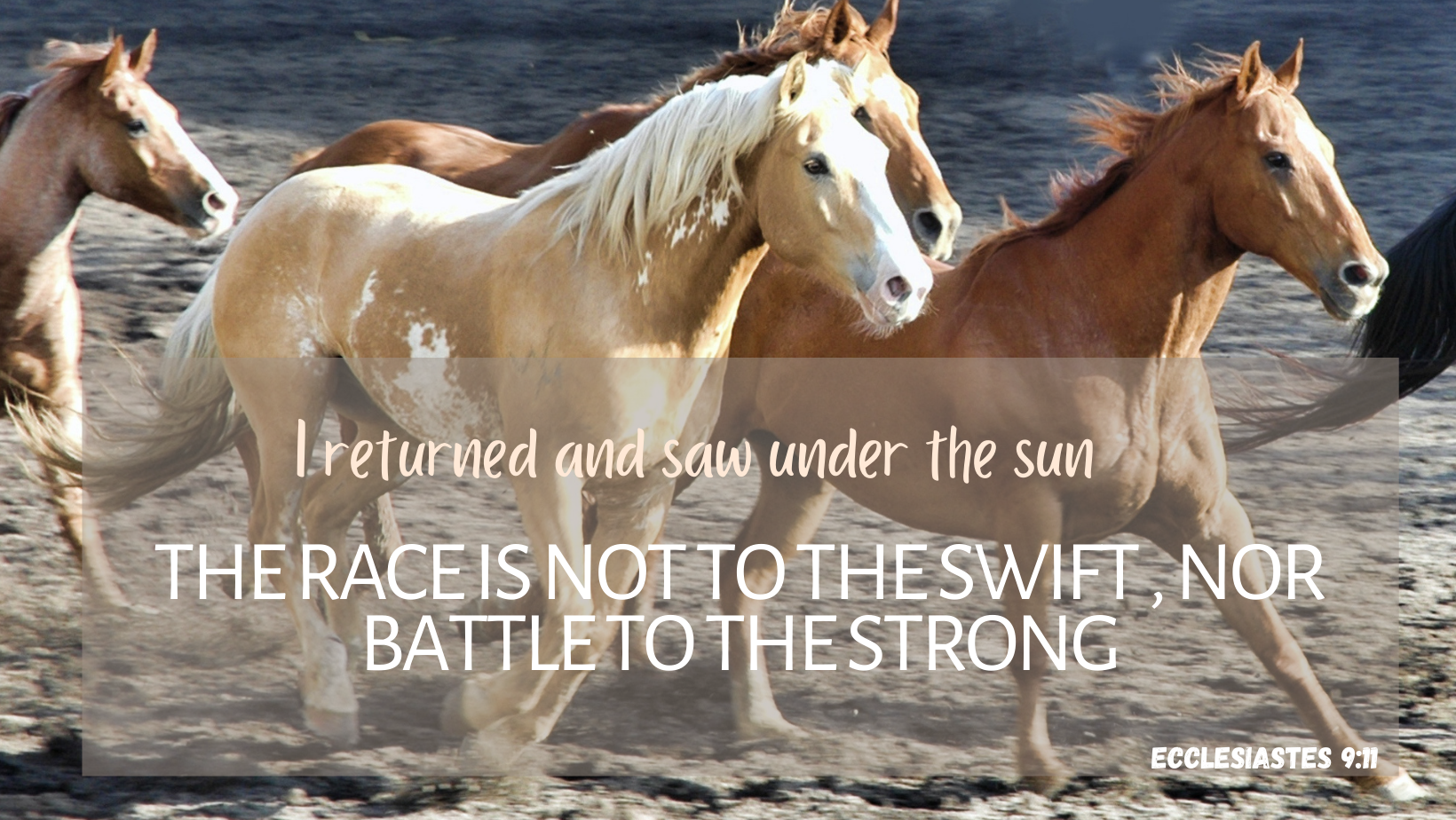
I returned, and saw under the sun,
that the race is not to the swift,
nor the battle to the strong,
neither bread to the wise,
nor riches to men of understanding,
nor favor to men of skill;
but time and chance happen to them all.
Ecclesiastes 9:11
The New York times carried a story about this famous author who wrote a best seller on running (Jim Fixx (b.1932), author of the seminal 1977 best seller "The Complete Book of Running). Prior to taking up running seriously, Jim was 214 pounds and addicted to smoking two packs of cigarettes a day. However Jim became devoted to running in 1967 at the age of 35. A decade later, The Complete Book of Running (on the best-seller list for 11 weeks) was published by him. He was 60 pounds less and smoke free. His book inspired many people. He extolled the benefits of physical exercise and how it considerably increased the average life expectancy of people in the book and in television talk shows.
But he collapsed and died suddenly at the age of 52 of a massive heart failure in Hardwick, Vt. He became the father of a running revolution in America. In memory of the legacy of the running guru a carved granite book with an inscription to him now stands in Hardwick Memorial Park, Vt . He had three partially blocked vessels (95%, 85%, & 50%). The medical experts say "Exercise helps reduce heart disease, but it's not absolute protection." Jim had a family history of poor hearts and his early unhealthy lifestyle caught up with him. His running may have extended his life by a few years, but could he have prevented the inevitable? It is true, life is unpredictable and whatever we do cannot protect us when the time comes for us to move on.
In life all of us are not equally endowed with all the gifts. To some although they may have been the fastest runner, strongest warrior, wisest person, or competent person, they are not always the ones who finally are the most successful. Overtime, due to various factors some become successful or victorious. Some become very rich and lead prosperous lives. The most important goal in our lives as Christians is to live our lives loving, trusting, obeying, and serving God. Paul says in Philippians 2:3 do not try hard to make a good impression on others, but be humble and think others as better than yourself. Paul further exhorts us to work hard and cheerfully as if we were working for the Lord rather than for people (Ephesians 6:7). We must learn to treasure each day that we live with gratitude and appreciation for God's presence in our our lives and the promise of the gift of eternal life with Him.
Friday, May 18, 2007
Navigating Life's Crossroads
Lessons from Solomon's Journey
In the tapestry of history, Solomon's life emerges as a vivid portrait of human frailty and divine grace. Like a physician squandering health and wealth to numb the pressures of existence, Solomon's journey is riddled with both triumphs and tragedies, offering profound insights into the human condition.
As we delve into the annals of biblical narrative, the juxtaposition between Solomon and his father, David, is striking. While David, amidst fleeing for his life from Saul's relentless pursuit, penned Psalms that continue to resonate with strength and solace, Solomon's path seems shrouded in ambiguity. David's simple yet profound words of wisdom, immortalized in Psalms 56:3, serve as potent reminders of the power of unwavering trust in God, even amidst overwhelming fear.
But did Solomon inherit this steadfast trust from his father? Or did he, perhaps, grasp God's will yet falter in obedience? These questions linger, echoing our own struggles with faith and obedience in the face of uncertainty. Do we, like Solomon, harbor fears of human judgment and succumb to the pressures of the world?
James, in his epistle, offers sage counsel on discerning God's will amidst life's complexities (James 4:13-15). He reminds us of the fleeting nature of existence, urging us to tread cautiously in presumptuous planning. Yet, this isn't a call to abandon foresight; rather, it's an invitation to intertwine our plans with unwavering faith in God's sovereign guidance.
Solomon's wisdom further illuminates this path, exhorting us to incline our ears to God's word and obey His commands. In Proverbs 2:1-5 and 3:5-6, he extols the virtues of trust and obedience, affirming that divine insight and direction accompany those who walk in faithful obedience.
And what of Jesus' timeless admonition in Matthew 10:28? He redirects our focus from earthly anxieties to the awe-inspiring majesty of God, who meticulously cares for every detail of our lives. In the light of such divine providence, fear of human judgment pales in comparison. For One who numbers the hairs on our heads, should we not trust Him with every facet of our existence?
In the tapestry of our own lives, may we find solace in the timeless truths echoed through the ages. As we navigate life's crossroads, may we emulate David's unwavering trust, Solomon's wisdom, and Jesus' radical call to fear God above all else. For in surrendering to the Shepherd's guiding hand, we find our truest purpose and deepest fulfillment amidst life's uncertainties.
Thursday, May 03, 2007
Streams of Living Water
As Paul embarks on his third missionary journey he comes to Ephesus. Here he meets twelve disciples of John the Baptist (Acts 19:1-7). Were they claiming to believers in Christ? Probably knowing that John's disciples may have not heard the whole gospel message, Paul inquired whether they received the Holy Spirit. They replied that they had never heard about the Holy Spirit. So he further questions them on what baptism they had received? They replied the baptism of John the Baptist. Who baptized them? Was it John, Apollos or some other? Here we see an independent stream not yet brought into the mainstream.
Paul explained to them that John's baptism was only to demonstrate their desire to turn from their sins and turn to God. Did such baptism lead the convert to live a new life in Christ? Shouldn't repentance for sins, accordingly lead to turning to Christ? It is when we allow Christ into our lives, through the working of the Holy Spirit in our lives we are able to live faithful lives. As soon as the disciples of John heard this they were baptized in the name of Jesus. When Paul laid his hands on them they received the Holy Spirit and spoke in tongues and prophesied. Was this not an observable proof of an outpouring, of the inpouring of the streams of living water (John 7:37-41)?
Do you see liberated or unconstrained streams breaking away from or being brought back into the mainstream today? What do you think someone like Paul's response to such streams would be?
Richard J. Foster in his book Streams of Living Water looks at six major streams of spirituality in Christianity: contemplative (prayer-filled life), holiness (virtuous life), charismatic (Spirit-empowered life), social justice (the compassionate life), evangelical (Word-centered life), and incarnational (sacramental life) of which Christ is the source of all these streams. Foster says: "God is bringing together streams of life that have been isolated from one another for a very long time." We can enrich and care for our souls if we draw from all these six streams which when we step back from it, we can see that all these little streams reveal to us the mainstream, proclaiming the message of Christ that none of these streams can tell by itself.
Tuesday, May 01, 2007
Found Wanting
The time between Paul's third missionary journey and the second there is a brief interlude. Suddenly there is the meeting of Apollos, John the Baptist disciple with Priscilla and Aquila , disciples of Christ. Apollos who had been baptized by John the Baptist and probably seen the the fulfillment of the Messiah in Jesus was preaching a message that was anachronistic to the one that the disciples of Christ were currently preaching (Acts 18: 24-28). Had Apollos not understood the role of the Holy Spirit after the resurrection of Christ? Did he know about the gifts of the Holy Spirit? Was he preaching purely a message of repentance and preparation for the coming of the Messiah? The story here is unclear what he said inaccurately.
When Priscilla and Aquila heard Apollos speak they realized that he was not entirely accurate. So they politely called him aside and made him understand the gospel message and enlightened him maybe on the role of the Holy Spirit during and after baptism. Here we see the pearls of spiritual knowledge that Paul had bestowed upon the couple now was passed on to another who could powerfully communicate it to those who were willing to hear and receive the gospel message. Do we show the same courtesy to other believers who have a different or an inaccurate point of view? Did Apollos have a problem learning from a couple who were not really educated but tradespeople? Do we know of someone who is in need of spiritual help? Can we ever claim to say we have fully understood the message of the gospel?
We have all on occasion met people who have a very charismatic personality, that draws people to them. Anything they say seem to touch the hearts and minds of those they interact with. Apollos was one of those people with the gift to teach and preach effectively. His burning enthusiasm to spread the message made him speak boldly and eloquently on the scriptures.
Saturday, April 28, 2007
End of Paul's Second Missionary Journey
Paul's extended stay at Corinth winds down as he ends his second missionary journey and returns to Antioch (Acts 18:12-23). Although at Corinth there is a final recorded encounter with the Jews. The Jews approached Gallio the Governor of Achaia and Paul was accused of breaking the law and making people worship God in ways contrary to the Roman law. Gallio wanted to have nothing to do with the finer details of what seemed to him as the teachings of Judaism and threw the case out of court.
He said that if they were making a compliant of some criminal misbehavior then he would listen, but if it only involves the finer details of the tenets of their faith juxtaposed to the new Christian school of thought, then they should settle the matter by themselves. The only person who got physically hurt was Sosthenes who was the leader of the Synagogue. He was publicly beaten by the mob for probably losing the case at court. Did this humiliation or something Paul said later make him become a close companion of Paul (1 Corinthians 1:1-3)? Crispus (Acts 18:8) his predecessor had joined Paul along with his household and many others much earlier. Although the Christians were hammered by the Romans and the radical Jews they did not retaliate physically and try to return tooth for a tooth. They stayed true to teachings of Christ that instructed them to turn the other cheek (Matthew 5:38-42), love their enemies (Matthew 5:43-48), and do good to those that persecute them (Matthew 5:10-12).
Despite the threats to destroy the faith, Christianity blossomed, flourished and gained momentum as Paul went through Ephesus, Caesarea, Jerusalem and then to Antioch. Although Paul's ministry slowly shifted away from the Jews to the Gentiles, he courageously defended the faith and bore the brunt of all the backlash that came against him.
Friday, April 27, 2007
Blossoming Church of Corinth
Paul spent considerable time in the synagogue debating and teaching to try to convince the Jews and Greeks about the gospel message. When Silas and Timothy came to Corinth, he spent even more time teaching and preaching. Did they bring for Paul flusher financial support, more moral support, or larger labor force? Have you explored the avenues where you can make your contribution to the church?
Paul's message in simple words was that Jesus was the Messiah the Jews were waiting for. But this did not sit well with the Jews, so after a while they opposed and insulted him. In response to their rejection Paul shook the dust of his robe and decided to focus on the Gentiles.
After all the unpleasantness with the Jews, Paul stayed with Titius Justus, a Gentile who lived next door to the synagogue. Paul also brought many to the faith in Christ including Crispus a leader of the synagogue and his entire household. Was this how the church in Corinth was born?
One night Christ (the light of the world) appeared in a vision and encouraged Paul not to be afraid. The inspiring words brightened his hope for the city of Corinth, and assured him that no one would harm him, because many people in the city believed in Christ (Acts 18: 9-10). This encouraged Paul to continue to minister to the people of Corinth for another year and a half. Did not Christ's assuring words hold true for Paul that he could continue to minister to the people of Corinth ? Have you experienced moments in your life when you have been enlightened by a word of scripture or a encouraging word from a fellow believer that has spurred you on in your journey?
Wednesday, April 11, 2007
Corinth
On his second missionary journey Paul moved from Athens to Greece. Corinth was a town around 50 miles away from Athens. It was here the famous Temple of Aphrodite (Goddess of love, lust and beauty) that lead people down the path of immorality, luxury and lust was located.
Paul met Priscilla and Aquila in Corinth. It is notable that the duo are always mentioned as a couple in the Bible. They had been expelled from Italy by the order of Claudius Caesar who issued a decree to deport all Jews from Rome. Were they expelled because of the tension that was growing among the communities of the Jews and Christians? Were they Christians before they met Paul? Did the Romans view Christianity as a branch of the Jewish Faith?
Here we see another dimension of Paul. He lived and worked with Priscilla and Aquila who were tent makers (leather workers). The Jews always raised their children to be proficient in some skill or profession so that they would be able to comfortably support themselves. For Paul tent making was the profession that sustained him while he pursued his career as a preacher. It also enabled him to travel widely as there was always a demand for tents that were largely used by the Roman soldiers. Is it not amazing that Paul says he toiled night and day so that he would not be a burden to anyone else (2 Thessalonians 3:8).
Tuesday, April 10, 2007
Sermon on Mars Hill
So they invited Paul to their council of philosophers at the Areopagus to hear his angle of thought and reasoning. It is here at Athens he gave the famous message at the Mars hill another name for Areopagus. He said,"Ye men of Athens, I perceive that in all things ye are too superstitious. For as I passed by, and beheld your devotions, I found an altar with this inscription, TO THE UNKNOWN GOD. Whom therefore ye ignorantly worship, him declare I unto you God that made the world and all things therein, seeing that he is Lord of heaven and earth, dwelleth not in temples made with hands, Neither is worshipped with men's hands, as though he needed any thing, seeing he giveth to all life, and breath, and all things."
He clearly said that our focus should not be on an idol crafted by man as our God. We are to repent of our sins and turn our hearts to a living God, who came down to earth as Jesus. Jesus died but was raised to life so that we may all hope in the gift of eternal life. Was this not what Jesus commissioned all his disciples to do when He opened their minds in Jerusalem after his resurrection (Luke 24:45-49)? Paul's message was on Christ our way, truth and life. It is through Christ we become part of the Kingdom of God. Some joined Paul as believers, of whom was Dionysius a member of the council of Philosophers. But to others the resurrection and the impending judgment seemed to be too far-fetched. Do you get discouraged when the gospel is rejected when you present it? Take courage, for there was a time when many deserted Jesus when He declared that he was the Way (John 6:60-66).
The response of the Athenians when they heard about the resurrection of a dead man, some of them laughed, others said they wanted to hear more later and only a few really believed. Don't we come across many who come to gatherings purely for discussion and debate. Paul cautions us not to waste our time in unproductive or fruitless conversations. Our joy, thanks and prayers should always be for those who believe that they may grow in their understanding and love for Christ.
So they invited Paul to their council of philosophers at the Areopagus to hear his angle of thought and reasoning. It is here at Athens he gave the famous message at the Mars hill another name for Areopagus. He said,"Ye men of Athens, I perceive that in all things ye are too superstitious. For as I passed by, and beheld your devotions, I found an altar with this inscription, TO THE UNKNOWN GOD. Whom therefore ye ignorantly worship, him declare I unto you God that made the world and all things therein, seeing that he is Lord of heaven and earth, dwelleth not in temples made with hands, Neither is worshipped with men's hands, as though he needed any thing, seeing he giveth to all life, and breath, and all things."
God has set the boundaries for the rise and fall of man. His purpose is that man will seek Him, and in the course of their exploration will find Him. God is not far away from us. We live, move and exist in God. We are His offspring. Paul declared that God is omniscient, omnipotent and omnipresent.
He clearly said that our focus should not be on an idol crafted by man as our God. We are to repent of our sins and turn our hearts to a living God, who came down to earth as Jesus. Jesus died but was raised to life so that we may all hope in the gift of eternal life. Was this not what Jesus commissioned all his disciples to do when He opened their minds in Jerusalem after his resurrection (Luke 24:45-49)? Paul's message was on Christ our way, truth and life. It is through Christ we become part of the Kingdom of God. Some joined Paul as believers, of whom was Dionysius a member of the council of Philosophers. But to others the resurrection and the impending judgment seemed to be too far-fetched. Do you get discouraged when the gospel is rejected when you present it? Take courage, for there was a time when many deserted Jesus when He declared that he was the Way (John 6:60-66).
The response of the Athenians when they heard about the resurrection of a dead man, some of them laughed, others said they wanted to hear more later and only a few really believed. Don't we come across many who come to gatherings purely for discussion and debate. Paul cautions us not to waste our time in unproductive or fruitless conversations. Our joy, thanks and prayers should always be for those who believe that they may grow in their understanding and love for Christ.
Monday, April 09, 2007
Chasing Shadows
In-Thing
The Perils of Modern Idolatry and Philosophical Distraction
At Athens Paul had many opportunities to debate with Epicurean (pleasure seeking) and Stoic (indifferent to or unaffected by joy, grief, pleasure, or pain) philosophers. Some of the famous philosophers whose school of thought that the Athenians followed were Aristotle, Socrates, and Plato (5th and 4th century BC). When Paul tried to present the gospel message to them they were surprised but indifferent to the message. They were far too absorbed in spending their time discussing the latest philosophies and thoughts that were prevalent and emerging in the world at that time.
Do you have any idols or what the idols personify in your life? Any that prevent you from coming close to the living God? Does your pursuit for wisdom, work, wealth, and war draw you away from God? Are you leading a life that is seeking only the pleasures that life has to offer?
Are we so absorbed in our own lives that we have lost touch with the needs of the poor and needy? Have we forgotten the words of Paul that says, Christ became poor so that we may become rich in Him (2 Corinthians 8:9). Is our faith shallow or deep? The idols we worship are lifeless, while our God is a life giving God. Jesus said, "I am come that they might have life, and that they might have it more abundantly(John 10:7-11)."
Sunday, April 08, 2007
Workers
Athens was a renown city for its centers for art, learning and philosophy. It still is one of the oldest cities in the world with a recorded history of more than 3000 years. Athens was named after the Goddess Athena. She was the goddess of wisdom, and cunning intelligence and discipline of war. She was often accompanied by an owl and the goddess Nike who personified victory.
At Athens Paul found that the prevalent culture was saturated with idols and idol worship. He was exceedingly distressed (Acts 17:16-21). Tarsus his birthplace also had a similar culture. He used to go to the local synagogue and speak to the Jews and the devoted Greeks. He also used to speak to any group of people who would listen to him at the public square.
Is our faith in Christ only a personal experience or is it to made public through proclaiming it in the streets, shopping malls and sports stadiums? God requires more people who have met Christ and have been transformed by the gospel message. God needs more people who are capable of communicating this gospel message to others. We grow and are nourished spiritually when we do the will of God for our lives. Jesus said, "One sows and another reaps(John 4:34-38)." Keep your eyes open there are always hearts longing for the seeds of the word of God to be sown. What is the joy of your calling as a worker?
Saturday, April 07, 2007
Fine-tooth-comb
They searched the Scriptures day after day to see if Paul and Silas were teaching the truth. (Acts 17:11)
The same night that Jason was falsely thrown into prison, the believers sent Paul and Silas away to the prosperous city of Berea( Modern day Veria), the chief metropolis in Macedonia at that time (Acts 17:10-15). When Paul preached in a synagogue they were more broad minded and gladly received the gospel message.
Here we see that the people were more scholarly in their approach to the faith. They searched the scriptures with a fine-tooth-comb and found that Paul was preaching the truth. Do you search the scriptures in depth, when you hear something different preached to you? Many Jews , some prominent Greek women and many men were brought to the faith. Here again Luke stresses that the people who were becoming believers were from all strata of society.
When the Jews in Thesalonica who were only 50 miles away from Berea, heard that Paul was preaching there, they came down and started creating trouble again. It is unknown how long Paul stayed at Berea few weeks or few months. Paul was immediately escorted to Athens by some believers. It is unknown whether he walked the distance or traveled by ship to Athens. Timothy and Silas remained to continue to minister to them. Later those who escorted Paul to Athens returned with the message that Timothy and Silas were urgently needed in Athens.
Friday, April 06, 2007
Topsy Turvy life
Paul and Silas traveled through the district of Macedonia and came to Thessalonica (Acts 17:1-9). Here we see that Paul customarily went for the synagogue services and in this case for three services in a row. He spoke to them about the prophesies and sufferings of the Messiah and His rising from the dead. Is it not amazing that the Jews welcomed Paul and Silas into their synagogues to listen to their sermons. Paul must have been such a powerful speaker that everybody wanted to hear what he had to say.
His sermons were so authoritative that some Jews, godly Greek men, and important women of the city converted to Christianity. It is interesting that Paul went first to the Jews and then to the Gentiles. In the process he formed a body of individuals of Jew and Gentile origin; rich and poor who became an active and vibrant church of Thessalonica.
The popularity of Paul and Silas made some of the Jewish leaders jealous. Were they angry that some Jews converted to Christianity or that Paul was speaking of Jesus as the Messiah? Were they jealous that Paul was drawing in Greek men and many prominent women into the Faith?
So they gathered a group of rowdies from the streets and attacked the home of Jason were Paul and Silas were residing. There are times when Christ is preached there is a chance for chaos and confusion to prevail. Here we see Jason a hidden gem of the faith,who entertained them as guests and by default was drawn into the dangers of being associated with the early Christian missionaries.
They had Jason and some other believers thrown in jail for treason against loyalty to Ceasar. Is it not ironic that as Christ hung on the cross Pilate had ordered that a notice be put stating this is the King of the Jews? Yet we must always remember that the path Christ chose was the path of suffering to enter into the Kingdom. Was not treason the same charge that Christ was sent to be crucified (John 19:12-16)? However Jason and the other believers posted bail and were set free.
Thursday, April 05, 2007
Burning the Midnight Oil
Praying & Singing Hymns
Acts 16:34 The jailer brought them into his house and set a meal before them; he was filled with joy because he had come to believe in God—he and his whole household.

Is it not wonderful that whatever may be our circumstances God is always listening to all our prayers and petitions. We see this joy in the life of Paul and Silas as they continue to faithfully praise and give thanks to God, even as they are shackled in prison for evangelism (Acts 16:25-34). It is this joy Paul and Silas experience despite being beaten black and blue and thrown in prison. They knew the joy of the presence of Christ would never leave them.
Suddenly around midnight the earth shakes and their hands fall free of the shackles. As the terror of the earthquake fills the night, prayers for freedom from their chains are answered. Yet they do not run away but stay on. When the doors of the prison fall open, the jailer is so afraid all the prisoners escaped, he almost kills himself. Yet Paul cautions him from the cell not to do so. The jailer is so grateful that he falls at the feet of Paul and asks what he must do to be saved? Paul tells him to believe in the Lord Jesus Christ.

Imagine the happiness of the jailer when he finds his prisoners still in jail. Coming to know Christ and the promise of eternal life is the key he unlocks to find freedom to everlasting joy. There is no guarantee our life is free from trials and tribulations on earth. However is it not wonderful that whatever our circumstances God is always listening to all our prayers and petitions ? Jesus' promise still stands if we ask in faith we will receive lasting joy of the Holy Spirit who renews and strengthens us every
The Jailer took Paul and Silas to his home and washed their wounds. He was overcome with joy over the gospel message that his entire household opened their hearts to the Lord Jesus and were baptized by them. The jailer who was terrified and almost took his life, came to know and experience the love of Jesus Christ and his heart was filled with joy and thanksgiving. What a transformation of a mans heart when the gospel message of grace and mercy was laid it.
Their sincerity to Jesus even at midnight to reach out to a terrified jailer with the gospel message is memorable story of the Acts of the Apostles. All this would not have happened if they tried to escape and ignore the trembling jailer. They could have escaped from prison and fled from Philippi disgraced, but with a dramatic turn of events they were honorably discharged with apologies from the city officials (Acts 16:35-40). Is this not the very essence of the gospel message, if we believe in the Lord Jesus we will inherit the eternal joy of living in the presence of God? In the parable of the Good and Faithful servants, Jesus concludes by saying well done and to enter into the joy of the Lord (Matthew 25:14-30).
Wednesday, April 04, 2007
Fortuneteller
At Philippi Paul and his team meet a slave girl who had the ability to tell fortunes (Acts 16:16-24). She was so good at what she did that she earned a lot of money for her slave masters. When the slave girl came across Paul and Silas she started following them around shouting that they were servants of the living God and were there to tell them how to be saved. When she did not cease to shout, after a few days Paul out of exasperation cast the demon out of her in Jesus name. Paul in his letter to Galatians specifically forbade us to not be a part in demonic activities (Galatians 5:16-26).
When the slave masters realized that their source of income was ruined, they created a big commotion in the town and dragged Paul and Silas to the city officials, had them beaten and thrown in Jail. To make sure they wouldn't escape they had their feet clamped and and thrown into one of the inner dungeons. For being faithful to God Paul and Silas had to endure the disgrace of being beaten in public and thrown in prison. Is this not a challenge to all of us that even though we may go through trials for standing up for the truth we should remain faithful.
Tuesday, April 03, 2007
Witch of Endor
The Old Testament has specific laws against prophecies given from other Gods or powers in the spiritual realm. If the prophecy is true we should further question ourselves on the source (Deuteronomy 18:21-22). We are expressly asked to see whether the prophesies draw us closer to God or away from Him. If they direct us to God then they are true prophets or if they draw us away from God they are false prophets (Deuteronomy 13:1-5).
King Saul was specifically condemned by the Prophet Samuel when he out of desperation tried to consult him through a witch (medium) at Endor after his death(1 Samuel 28:1-25). Did Saul really speak to Samuel who had died? Was Saul's concern more about his own future plans as opposed to the future plans he had in God? Had not Samuel clearly told him that God had rejected him from being King (1 Samuel 15:1-23)? Why was Saul living in denial of what he had heard what Samuel had already told him before he died? King Saul was so overwhelmed with jealousy and anger toward David, the anointed King of Israel, that he kept hoping against hope that one of his own sons would follow as King after his time.
Let us not out of our own desperation or anguish try and seek refuge and solace in mediums that will draw us away from our Heavenly Father. When we move away from God and shift our focus on other sources we lose our hold on God and find ourselves in distress and despair. Our focus must always be on God who loves and cares for us.
Monday, April 02, 2007
Open and Shut Doors
Open and Shut Doors

As Paul and Silas continued on their second missionary trip through Phyrgia and Galatia, the Holy Spirit told them not to go to Asia and Bithynia. There are times in our own lives when the Holy Spirit advises us to stay away from some areas. It is through prayer and keeping our eyes open we discern what God plans for us to do. Then again one day Paul had a vision of a man standing before him from Macedonia (Modern day Greece) and he was convinced, that was where the Holy Spirit was leading them to next.
As Paul journeys on, Luke the author of Acts joins them (Acts 16:11) as they head toward Philippi in the district of Macedonia. Here they meet Lydia a wealthy business women and some other women. They listen to Paul's gospel message and open their hearts to Christ and are baptized by Paul. Lydia invites them to stay with her in her house during their stay there. Could this have been one of the earliest women's fellowships in the early years of Christianity? Lydia and her friends played an instrumental role for the growth and ministry of the church in Philipi.
Sometimes we may not understand why the Spirit of Christ opens some doors and closes others. But in the life of Paul, he was able to build a strong relationship with the churches and in the later part of his life when he spends time in Rome at prison, he writes letters to these churches. These letters today have been treasured and accepted all over the world as part of the inspired Word of God in the Bible.
Prayer:- Dear Lord open our eyes to see your hand leading us as we discern your plans for our life ahead. Strengthen us to stay faithful to the growth and ministry of the church when we encounter obstructions along the way. Amen
Sunday, April 01, 2007
Mission Focused
Mission Focus
For I have no one like Timothy, who naturally cares for your wellbeing. For all seek their own interests, not the things which are Jesus Christ's. (Philippians 2:20-21)
Paul on his second mission trip brought Silas along and came to Lystra where they met Timothy (Acts 16:1-5). They were convinced that Timothy would be a good travel companion for them. Timothy was well respected by believers in Lystra and Iconium and Paul knew that he could use him for preaching the Word during his mission trips.
Timothy's grandmother and mother were strong believers and had been raised him in a good Christian home. Although Timothy did not have to be circumcised, Paul urged him to do so anyway. This act of his to go beyond the call of duty was done out of reverence and respect for the Jewish believers. Their ministry strengthened the faith of the churches and many were brought to Christ.
Paul decision to make Timothy join them proved to be very valuable choice, as he stayed on with Paul till he reached Rome. There he was a source of great support and encouragement for Paul especially when he was imprisoned in Rome. Paul looked upon Timothy as his own son(Phil 2:19-24). Paul was grooming him to continue his ministry after his time. Paul said that Timothy's focus was always on the matters that concern Jesus Christ.
Finding the right people who will be faithful and loyal to the mission of the group or organization they serve, is part of the process of building a praiseworthy ministry.
Thursday, December 21, 2006
Hope of the World
Hope of the world
Now faith is the substance of things hoped for, the evidence of things not seen. Hebrews 11:1
Now faith is the substance of things hoped for, the evidence of things not seen. Hebrews 11:1
What would our lives be if we did not have hope that we will have a great day and a life ahead of us?
As people of faith we thank God for his continuing presence in our lives and the strength of our faith that has become more well founded as the years go by. In Christ we discover and apply our spiritual gifts to bring glory to God. We love to worship and pour over His word. We find our niche in serving the poor and needy with our gifts and abilities.
Yet there are many who have lost hope and are living in darkness. Let us share our spiritual life experiences with them that the things we hope for may become a new living hope in their lives. Let us not let any opportunity slip by where another may be dressed in the same raiments of glory that adorn us. The awareness and the presence of Jesus brings hope. Christ is coming again! Brings hope! Let us seize this time to share our message of hope to all of human kind.
May the God of hope fill you with all joy and peace as you trust in him, so that you may overflow with hope by the power of the Holy Spirit. Romans 15:13
Sunday, December 17, 2006
Fires of Joy @ Christmas
Feux de Joie
Embracing the Joy of Christmas
"Rejoice in the Lord always:
and again I say, Rejoice."
— Philippians 4:4
The Season of Joy
Christmas is here! It is a time when many of us as Christians will gather with family and friends to celebrate. It's a season filled with joy, warmth, and togetherness. We exchange gifts, share delicious meals, and rejoice in the fellowship we share with one another. It's a time to celebrate the birth of our Savior, Jesus Christ, and reflect on the immense love and grace He has bestowed upon us.
Feux de Joie: Fires of Joy
In Louisiana, a unique and vibrant tradition lights up the riverbanks of the Mississippi from Baton Rouge to New Orleans. Bonfires are set ablaze to guide Papa Noel (Santa Claus) as he sails down the river in his paddle boat. This celebration is called Feux de Joie, which means "Fires of Joy." The sight of these bonfires not only illuminates the night but also symbolizes the joy and light that Christmas brings into our lives.
Let this be a time when we have our own Feux de Joie burn in our hearts, passing the joy and light of Christ to all those we meet during this season. Just as the bonfires guide Papa Noel, let us be guiding lights to those walking in darkness, steering them to see Christ, the light of the world, the Savior who is born.
Being the Light
As we navigate through the hustle and bustle of the Christmas season, it's easy to get caught up in the material aspects of the holiday. However, let us not forget the true reason for our celebration: the birth of Jesus Christ. This season, let us embody the joy and light of Christ, spreading it to everyone we encounter. Here are a few ways we can be guiding lights:
1. Acts of Kindness: Simple acts of kindness can make a significant impact. Whether it's helping a neighbor, volunteering at a local charity, or simply offering a smile and a kind word, these gestures reflect the love of Christ.
2. Sharing Our Faith: Take opportunities to share the story of Jesus' birth and the true meaning of Christmas with those who may not know it. Use this time to witness and spread the gospel.
3. Supporting the Needy: Many people struggle during the holiday season. Reach out to those in need, offering support, whether it be through donations, providing meals, or simply being a friend to someone who is lonely.
A Time to Rejoice
The apostle Paul reminds us in Philippians 4:4 to "Rejoice in the Lord always: and again I say, Rejoice." This Christmas, let our rejoicing be evident in our actions and interactions. Let the joy of Christ overflow from our hearts and touch the lives of others. As we gather with our loved ones, let us take a moment to reflect on the incredible gift of Jesus and allow that joy to fuel our celebrations and our lives.
Conclusion
As we celebrate Christmas, let us carry the spirit of Feux de Joie within us, lighting up the lives of those around us with the joy and love of Christ. May we be beacons of hope and joy, steering others towards the light of the world. Merry Christmas, and may your hearts be filled with the true joy of the season!
Prayer
Dear Lord, as we enter into this season of celebration, we thank you for the gift of your Son, Jesus Christ. May our hearts be filled with the joy of His birth, and may this joy overflow to all those we encounter. Help us to be shining lights in a world filled with darkness, guiding others to experience the true meaning of Christmas. In Jesus' name, we pray, Amen.
Sunday, August 27, 2006
Sunrise
Then he went down to Nazareth with them and was obedient to them. But his mother treasured all these things in her heart. And Jesus grew in wisdom and stature, and in favor with God and men. Luke 2:51-52
The "Infancy Gospel of Thomas" was a contribution from the Hellenistic (Greek) literature of the second and third centuries. Jesus is pictured as a boy wonder who scared his friends, performed miracles for the fun of it, and disrespected his teacher. If that is the case, today our kids may call the boy Jesus an X Man of sorts, a mutant with extraordinary powers that humans do not possess. However, this gospel is a figment of the imagination of a philosopher, Thomas, who lived during that period. So little is known or recorded about Jesus’ childhood that the temptation to imagine Christ's childhood was what probably prompted this work of fiction. It is impossible to reconcile the behavior of the Jesus described in the biblical gospels with the behavior of the child Jesus conveyed by the false gospel account.
Mary and Joseph had come to Jerusalem for the Passover with Jesus when he was twelve years old. In Jewish tradition, this was a very important year for Jesus when he was officially inducted into the understanding of the law. At the temple, speaking to the Jewish elders he must have been fascinated by their knowledge and customs. Being extremely pious, he must have sensed the presence of God in the hearts and minds of those who worshipped in the temple. When it came time to leave, it was customary for women to go ahead of the men. So Mary may have thought Jesus was with Joseph, while Joseph may have thought Jesus was with Mary. In the confusion, Jesus was left behind in the temple. This was probably a situation similar to that in the popular movie series "Home Alone" where the youngest son was left behind at home. Maybe when Joseph and Mary met up at some point, it dawned on them that Jesus was missing. I don’t think it was a question of obedience but just a slip up.
Jesus was surprised when his mother said that they had been very worried when they couldn’t find him. He asked her, “How is it that you looked for me? Didn’t you know that I would be in my Father’s house?” Mary had seen visions and heard about the visions of others concerning Jesus. There was no need to have been worried about Jesus. He was clearly being looked after by his heavenly Father, who had placed him on earth for a specific purpose. Is it not human for us to worry about our loved ones, forgetting that God our Father loves them more than we do? Could Mary have been one of his earliest disciples?
Luke clearly portrays Jesus as an obedient child, one who was very well read and considered the temple as his Father's house. His insight into the Torah was so astute that even the teachers were amazed at his understanding, questions, and answers. Mary and Joseph had the unique privilege of being the earthly parents of the Son of God. Luke clearly says that everything Jesus did and said was fondly treasured in the heart of his mother, Mary. As the sun rises in the east slowly, it is a glorious sight to behold. It is the birth of a new day. Similarly, this was the dawn of the life of a young man who would go on to shine his light into the hearts of millions of people for centuries to come.
Saturday, August 26, 2006
Divine Dismissal
“Lord, now You are letting Your servant depart in peace, According to Your word; For my eyes have seen Your salvation Which You have prepared before the face of all peoples, A light to bring revelation to the Gentiles, And the glory of Your people Israel.” Luke 2:29-32
The song of Simeon today is called the "Nunc Dimittis." In Latin the words mean, "Now you are dismissing" and it is often used during evening prayers. To Simeon it was a divine dismissal from a promise given to him by the Holy Spirit that he would see the Messiah before he died. Simeon and many others had waited patiently for years for this day. They waited quietly, expectantly, humbly, and hopefully. Jesus was immediately recognized by Simeon, a very old man in the temple, as the Messiah. He declared that Christ would bring salvation and be a light to all people.
Yet only two pigeons were offered as a sacrifice for the ceremony. This clearly shows the poverty into which Christ was born. Christ was not born into a royal palace or a holy priest's house but into the home of a humble carpenter. Here we see God coming down not to rule the world, but in humility to be involved in the life and strife of the poor and downtrodden. God fulfills what the prophets of old had foretold, that Bethlehem in Judah would be where the Messiah would be born (Micah 5:2-5). We see how a public decree by a Roman Emperor would cause Mary to travel many miles from Nazareth to register herself in Bethlehem.
Even in the rejoicing, Simeon said, "Behold, this Child is destined for the fall and rising of many in Israel." In Christ we will all rise again. It is His sacrifice on the cross that causes us all to rise from the dead. In Christ we abandon our old life and rise to find a new one in Him. Simeon also warns that there will be many who will also fall. There will be many who one day will face eternal condemnation because they did not believe.
I was watching the harvest festival 2006, where Greg Laurie spoke about the end times. He said that many people come to him and ask, “are we in the end times?” He is convinced that we are. He used the analogy of the birth of his grandchild. As the time for the delivery approached, the labor pains started. These pains were the signs of the impending birth. So also we live in a time where there are wars and rumors of wars, pestilences, earthquakes, tsunamis, persecution of Christians, and a heightened hatred against Israel. These are the labor pains that were foretold before the second coming of Christ. These are times when just as Simeon did, we should watch and pray. Let us wait peacefully, confidently, humbly, and hopefully.
Thursday, August 24, 2006
Steadfast Heart
And she was a widow of about fourscore and four years, which departed not from the temple, but served God with fasting and prayers night and day. Luke 2:37
Today during our evening meditation we reflected on the life of Anna and how she spent all her time in the temple fasting and praying. I asked my son, "How many times do you think of God during the day?" He said often. So I asked when he had prayed today. Without blinking an eyelid he said he prayed throughout the day that I would not give him any assignments to do. Honestly speaking, many of us silently pray that we won’t have to do some humdrum duty that requires our physical or mental effort with no real tangible goal in sight. How often do we think or pray to God during our daily activities? Have you tried fasting from food or something you particularly enjoy doing viz. surfing on the internet, watching your favorite TV program, or going window shopping? The time spent during that favorite activity could be substituted for prayer or some other form of service to God.
Anna was a prophetess who lived in the temple all day and spent much of her time fasting and praying. Her greatest moment was to be in the presence of the baby Jesus Savior … Messiah … Lord ... Prince of Peace ... God with us ... Immanuel. What more could she ask for than to be physically in the presence of God our Savior? Mary and Joseph brought their son Jesus, to dedicate him for service to God. Mary had heard the shepherds declare to her what the angel had said, "For unto you is born this day in the city of David a Savior, which is Christ the Lord. And this shall be a sign unto you; Ye shall find the babe wrapped in swaddling clothes, lying in a manger (Luke 2:11-12)." This witness of these poor simple shepherds may have caused Mary to ponder on the significance of Christ's mission on earth. Have you had moments in your life when you were consciously aware of the presence of God?
Simeon further gave Mary some shocking news that, "Yea, a sword shall pierce through thy own soul" (Luke 2:35). Mary was called to be the mother of baby Jesus, yet in the joy of motherhood to the Messiah, here was Simeon prophesying that she would be inflicted with a sword of great suffering as well. The life that Jesus would lead would be one of rejection that would eventually lead Him to the cross. Have you been called to Christian service, yet decided against it because the cross was too heavy to bear? Or has tragedy and life’s battering left your heart drained and helpless?
Here Anna, who had spent a lifetime of prayer and fasting, now started speaking about Jesus to all she met who were waiting expectantly for the day of deliverance. We must believe that our Heavenly Father knows what is best for us. Let us always hope even when there are no answers in sight. Let us trust even in times of failure. Let us pray for and share all we have with those in need. To have a steadfast heart and not grow bitter when we are burdened with sadness and grief is our calling as Christians. He will have no fear of bad news; his heart is steadfast, trusting in the Lord (Psalm 127:7). God’s is waiting for people, churches, and nations to admit their absolute faith in Him and His abundant grace. God's spiritual blessings will rest upon those who commit themselves with obedient spirits and steadfast hearts.
Subscribe to:
Posts (Atom)